03Building blocksLoad balancers
03 · Building block
Load balancers
Distribute traffic, detect unhealthy instances, preserve affinity only when necessary, and remove single points of failure.Architecture map
See where the component sits in a real system.
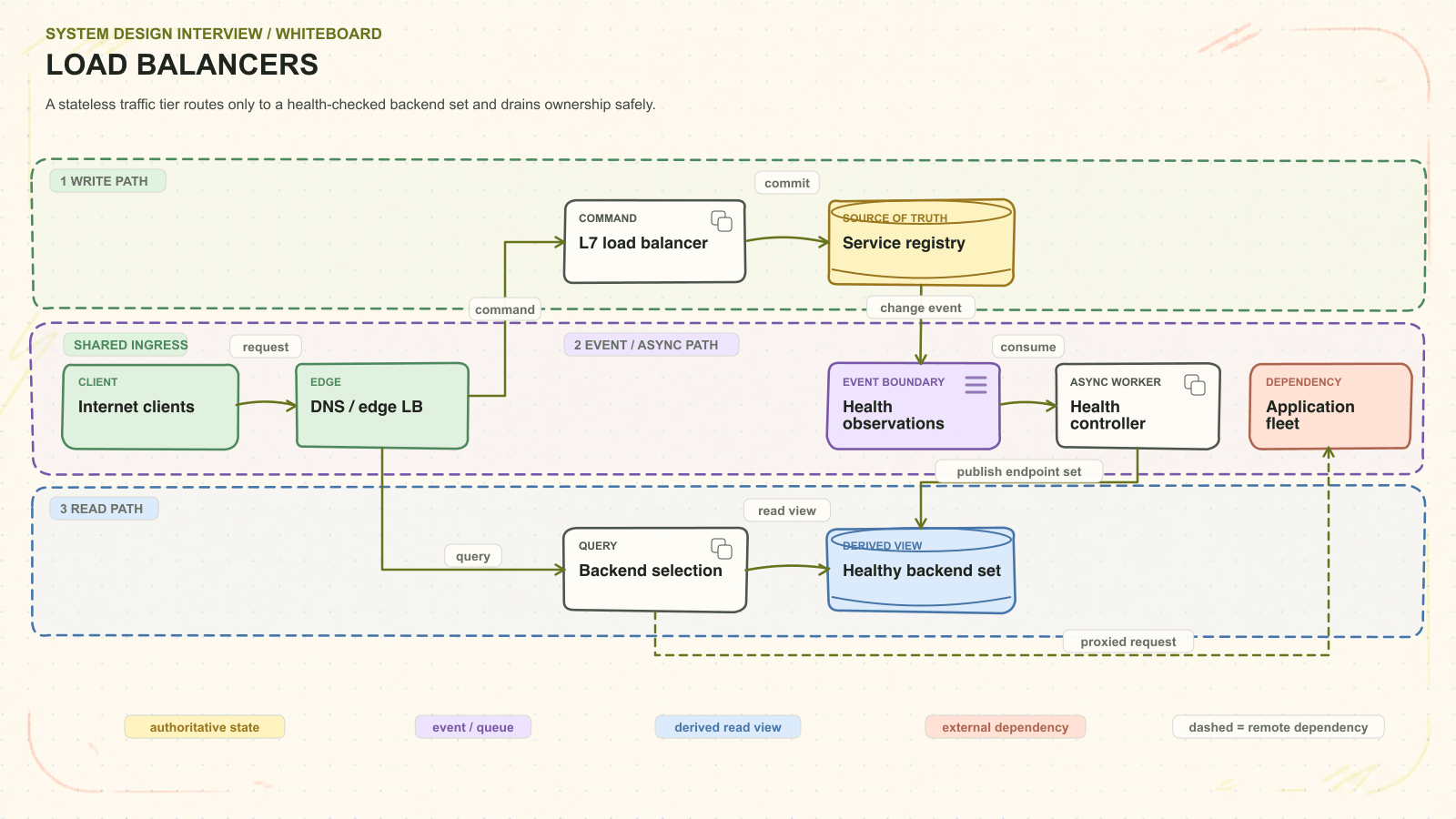
Write
Internet clients enters through DNS / edge LB. L7 load balancer owns validation and commits the durable record to Service registry.
Propagate
Health observations separates the committed write from background work. Health controller can retry safely while it builds Healthy backend set.
Read
Backend selection serves from Healthy backend set, then checks authoritative state whenever freshness, policy, or correctness requires it. It also consults Application fleet as an explicit dependency.
Say this first: A stateless traffic tier routes only to a health-checked backend set and drains ownership safely.
Open the full whiteboard ↗Explain every boundary before adding more boxes.
A stateless traffic tier routes only to a health-checked backend set and drains ownership safely.
Distribute traffic, detect unhealthy instances, preserve affinity only when necessary, and remove single points of failure.
Peak connections · QPS · TLS cost · cross-zone traffic · failover headroom. State average and peak load, stored bytes, bandwidth or open connections, and the growth horizon before choosing a partitioning strategy.
End-to-end walkthrough
Trace the architecture in this order.
- 01
Enter and classify the request
Internet clients → DNS / edge LBHTTPS requests enters over HTTPS / RPC. DNS / edge LB handles identity, admission, routing, and request context; it deliberately does not own domain truth.
- 02
Validate, then cross the commit boundary
DNS / edge LB → L7 load balancer → Service registryL7 load balancer receives the command, checks invariants and retry identity, then uses commit to update Service registry. The user-visible mutation is accepted only after this boundary succeeds.
- 03
Move replayable work off the request path
L7 load balancer → Health observations → Health controller → Healthy backend setL7 load balancer emits publish after commit; Health controller uses consume and publish endpoint set to build Healthy backend set. Consumers must tolerate duplicate delivery and stale retries because this path is asynchronous.
- 04
Serve reads from the right authority
DNS / edge LB → Backend selection → Healthy backend set / Service registryBackend selection uses optimized read for the common, read-optimized path and watch registry when correctness or repair requires authoritative state. The API must state the freshness promise instead of hiding it.
- 05
Contain the dependency boundary
L7 load balancer → Application fleetproxied request crosses into Application fleet. Treat timeouts as ambiguous, use a deadline and idempotent retry or reconciliation, and keep the core state recoverable when the dependency is unavailable.
Ownership ledger
Why each box exists—and what it must defend.
| Component | Owns | Why it exists | Interviewer probe |
|---|---|---|---|
| DNS / edge LBRegion + anycast routing | Identity, admission, routing | Protects the system edge and attaches trusted context before domain work begins. | Timeout budgets, quotas, regional routing |
| L7 load balancerTLS, routing, affinity | Write invariants and retry identity | Serializes or conditionally applies state changes before acknowledging success. | Concurrent writes, deduplication, hot ownership |
| Service registryDesired endpoints + weights | Authoritative durable state | Provides the one record used to resolve disputes, recover, and rebuild projections. | Partition key, replication, consistency |
| Health observationsActive + passive checks | Durable asynchronous handoff | Absorbs bursts and lets slow or optional work retry independently of the request. | Ordering key, lag, retention, dead letters |
| Health controllerEject, recover, drain | Replayable processing | Runs expensive, fan-out, or side-effecting work with leases and bounded retries. | Idempotency, poison work, autoscaling |
| Healthy backend setLocal routing snapshot | Rebuildable query state | Shapes data for the dominant reads without weakening the write-side invariant. | Freshness, versioning, rebuild time |
| Backend selectionLeast-load / hash / RR | Read composition and freshness policy | Chooses authoritative or derived state and returns a stable client contract. | Fan-out, cache policy, partial results |
| Application fleetStateless service instances | External capability, not local truth | Keeps a specialized or third-party concern behind a replaceable contract. | Ambiguous timeout, circuit breaking, fallback |
Physical design
Name the database, shard key, indexes, and guarantees.
- Database + storage
- Stateless L4/L7 balancers use etcd/Consul or managed registry truth and local in-memory healthy endpoint snapshots.
- Partitioning / sharding
- Partition traffic by region/service; use rendezvous hashing only when affinity/cache locality is a stated requirement.
- Indexes
- Registry by service/zone/state; local endpoint array/ring; health windows by endpoint; route trie for L7.
- Replication + consistency
- Config/registry versions are strong; health is freshness-bounded. Last-known-good snapshots keep data plane alive during control loss.
- Cache, queue + recovery
- Active/passive health, slow start, bounded ejection, draining, retry budgets, and zone-aware routing form the failure policy.
- Capacity math
- Estimate QPS, connections, bytes/sec, TLS handshakes, backend count, zone loss, and longest request for draining.
- Alternative rejected
- Round robin is correct for uniform work; least-load/EWMA/hashing needs variable cost or affinity evidence.
Deep-dive candidates
Pick one risk and explain the mechanism, alternative, and cost.
Layer 4 vs layer 7
L4 routes connections with low overhead; L7 understands HTTP, hosts, paths, headers, and application policy.
Tie the mechanism back to Service registry, Healthy backend set, and the stated peak connections · qps · tls cost · cross-zone traffic · failover headroom envelope.Algorithms
Round robin suits similar requests; least connections or response time helps variable work; weighted policies reflect unequal capacity.
Tie the mechanism back to Service registry, Healthy backend set, and the stated peak connections · qps · tls cost · cross-zone traffic · failover headroom envelope.Health checks
Combine active probes with passive error signals, slow start, draining, and bounded ejection so deployment churn does not become an outage.
Tie the mechanism back to Service registry, Healthy backend set, and the stated peak connections · qps · tls cost · cross-zone traffic · failover headroom envelope.Failure pressure test
Show detection, containment, recovery, and evidence.
The topic-specific correctness risk
Slow or flapping instances can pass shallow health checks and absorb failing traffic.
Track failed promises at Service registry and Healthy backend set.Health observations or Health controller falls behind
Bound admission, scale on oldest-work age, retry with jitter, and isolate poison work before lag becomes unbounded.
Oldest event age · retry rate · dead-letter volume · projection freshnessService registry is slow or unavailable
Apply a deadline, preserve retry identity, fail over only within the stated consistency model, and reconcile any ambiguous result.
Commit p99 · timeout rate · replication lag · recovery time- Functional requirements and non-goals
- Peak traffic, storage, bandwidth, and growth
- Entities, APIs, idempotency, and pagination
- Source of truth and consistency promise
- Partition key, replicas, caches, and hot spots
- Retries, backpressure, failover, and reconciliation
- Latency, saturation, correctness, and recovery metrics
- Security, migration, cost, and multi-region evolution
Read the solid request path first, stop at the source of truth, then follow the dashed event path into workers and rebuildable read models. Every arrow names a contract you should be ready to defend.
- 01
Client — Resolves the service Define the output contract before moving to the next owner.
- 02
Global router — Chooses a region Define the output contract before moving to the next owner.
- 03
L7 balancer — Routes requests Define the output contract before moving to the next owner.
- 04
Service pool — Handles stateless work Define the output contract before moving to the next owner.
- 05
Health system — Removes bad instances Define the output contract before moving to the next owner.
- 06
Autoscaler — Adjusts capacity Confirm the result and emit the evidence needed to reconcile it.
Lesson spine
What you need to understand.
Load balancers distribute work and remove unhealthy capacity while preserving the routing information the application actually needs.
Layer 4 vs layer 7
L4 routes connections with low overhead; L7 understands HTTP, hosts, paths, headers, and application policy.
Algorithms
Round robin suits similar requests; least connections or response time helps variable work; weighted policies reflect unequal capacity.
Health checks
Combine active probes with passive error signals, slow start, draining, and bounded ejection so deployment churn does not become an outage.
Affinity
Use sticky routing only for state that cannot yet move; prefer external session state so a failed instance is replaceable.
Global routing
Use latency, geography, regulation, and regional health to select an entry region, then balance locally.
Zero-downtime changes
Register new capacity, verify readiness, shift traffic gradually, drain old connections, and retain rollback.
Before the boxes
Frame the decision.
What must work
Distribute traffic, detect unhealthy instances, preserve affinity only when necessary, and remove single points of failure.
What changes the design
Peak connections · QPS · TLS cost · cross-zone traffic · failover headroom
What owns the truth
Identify the component that commits authoritative state, then separate synchronous confirmation from derived work.
What stays simple
Do not add global coordination, multi-region writes, or a specialized store until a requirement earns the complexity.
Decision table
Make the trade-offs explicit.
| Decision | Defensible position | Cost to acknowledge |
|---|---|---|
| Primary mechanism | Layer 4 minimizes overhead; Layer 7 earns application-aware routing and policy. | The stronger guarantee usually adds coordination, latency, state, or operational work. |
| Sync vs. async | Keep only correctness-critical confirmation synchronous. Move derived views, notifications, analytics, and cleanup behind a durable boundary. | Async work needs idempotency, lag monitoring, replay, and a product definition for partial completion. |
| Simple vs. scaled | Begin with one logical owner and a clear API. Partition or replicate only the resource proven to be the first bottleneck. | Migration requires stable identities, versioned contracts, backfill, and a rollback path. |
Failure review
Design the recovery path.
Topic-specific risk
Slow or flapping instances can pass shallow health checks and absorb failing traffic.
ResponsePersist enough identity and state to distinguish retry, resume, compensation, and operator repair.
Dependency timeout
A timeout is ambiguous: the remote side may have failed, succeeded, or still be running.
ResponseUse deadlines, bounded backoff with jitter, idempotency keys, and a status or reconciliation path.
Overload or skew
Average capacity can look healthy while a tenant, key, partition, region, or expensive request saturates one owner.
ResponseExpose queue depth and hot-key share, apply backpressure, isolate tenants, and degrade optional work before correctness.
Evidence + level bar
Prove the design can be operated.
Health of the promise
Measure user-visible latency or freshness, correctness drift, saturation, retry volume, and time to recover. Alert on the failed promise—not only CPU.
Complete and clear
Finish the happy path, identify the state owner, choose reasonable building blocks, and explain one scale mechanism.
Trade-offs and failure
Separate read and write paths, define consistency, explain partitioning, and make duplicate or partial failure safe.
Evolution and operations
Discuss multi-region boundaries, migration, tenant isolation, capacity, observability, and how the architecture changes over time.
Interview language
Open the deep dive with a claim.
“For Load balancers, the decision I want to make explicit is this: Layer 4 minimizes overhead; Layer 7 earns application-aware routing and policy. I’ll trace the state-changing path first, show where the result becomes durable, then test the design against the highest-risk failure and our target scale.”
08 · Retrieval check
Can you defend it without the page?
- For Load balancers, where is the correctness boundary and which failure would you test first?
- Which component owns committed truth, and what event or response proves the commit?
- Where is the first scaling or coordination bottleneck under the stated envelope?
- What happens after an ambiguous timeout or duplicate operation?
- Which complexity would you remove at one hundredth of the scale?